Run 07 · Live Intelligence · field test
Docket: the courts at the free mirror, and a reading room that admits its gaps
We ran the search the Supreme Court filter builds, probed the full-text relay, and compared the desk with CourtListener itself and Google Scholar's case law.
Brief
What it is, and who it is for
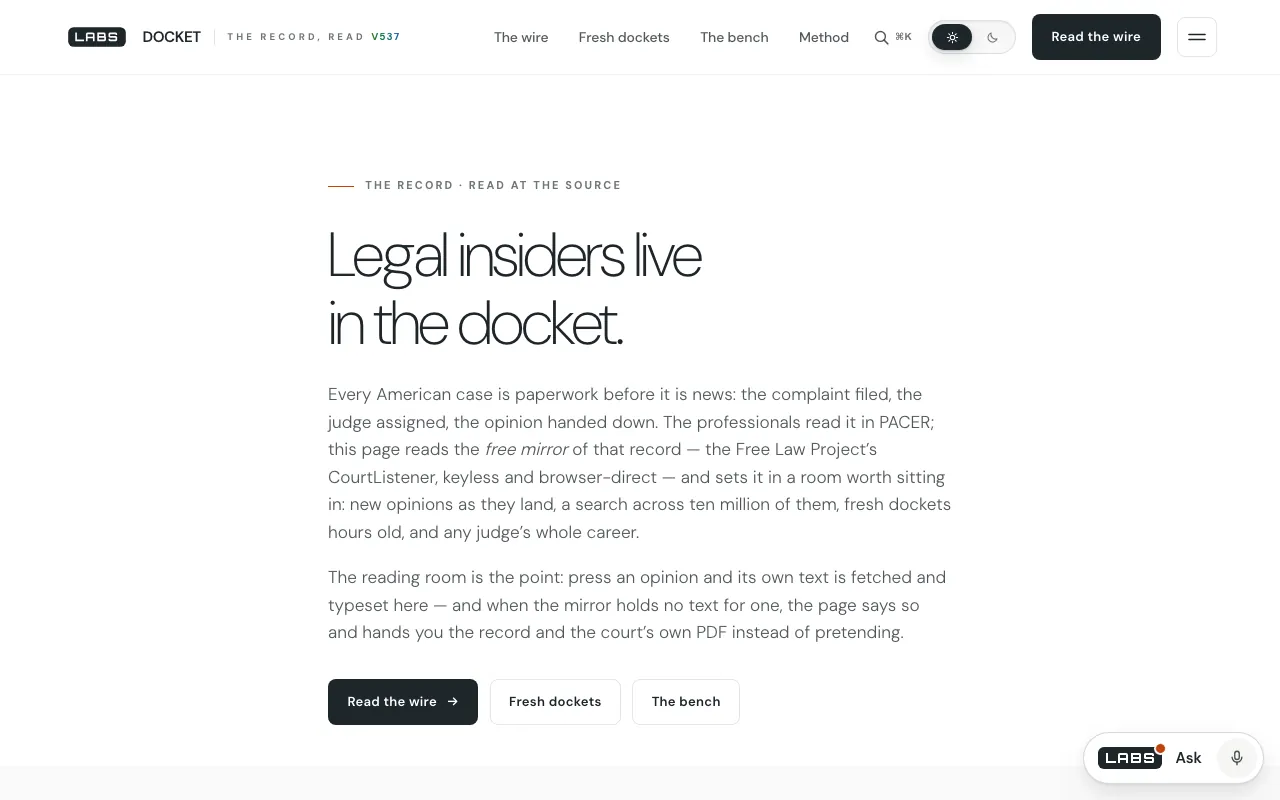
Docket is a court-record desk built on the Free Law Project's CourtListener API. It shows a wire of the newest opinions — all courts, the Supreme Court alone, or the thirteen federal circuits — full-text search across opinions, a reading room that typesets an opinion, federal dockets filed in the last fourteen days, and a judge lookup with each judge's seats and appointers.
Journalists, students and curious readers can see what the courts decided this week and read it, without an account.
Wiring
Where the work happens
The browser calls CourtListener's v4 REST API directly; it is keyless for searches and open to cross-origin reads. The wire is an opinion search ordered by filing date with a court filter; dockets are a search limited to fourteen days; the bench is a people search. A 429 is reported as the mirror asking anonymous readers to slow down. Full text needs a token, so it goes through docket/relay.php, which takes only a numeric opinion id and never follows redirects. With no token installed the relay answers 501 and the reading room shows the index's opening lines.
Sources it reads
- CourtListener v4 search — opinions, RECAP dockets and judges — browser-direct.
- CourtListener's opinion detail endpoint, through the token relay, only when a token is installed; courts' own PDFs linked.
Run table
The run, row by row
| # | Time | Probe | Returned |
|---|---|---|---|
| 01 | Loaded /docket/ from the local copy | HTTP 200, 40,073 bytes. | |
| 02 | Asked the relay for opinion 12345 | HTTP 501: 'no token installed — the reading room shows the snippet instead'. The tree holds no token file, so we cannot say whether the live site has one. | |
| 03 | Asked the relay for opinion abc | HTTP 400: 'op must be a numeric opinion id'. | |
| 04 | CourtListener opinion search, Supreme Court, newest first, with a labs.llc Origin | HTTP 200, 41,295 bytes in 0.75 s; CORS header returned; 20 results, the newest two filed 25 Sep 2026. | |
| 05 | Tried courtlistener.com; read free.law's project page insteadrival page | The site returned 403 to our fetcher. Free Law's page: over 10 million opinions, the RECAP archive, judges, oral arguments, alerts, APIs. | |
| 06 | Read Google Scholar's help pagerival page | Coverage stated per court level; court selection; citations. |
Findings
The lengths it goes to
- It never passes a fragment off as the whole. Without the token the reading room shows the opening lines, says that is all it has, and links the record and the court's own PDF.evidence · docket.js 143–170; run row 02
- The token relay cannot be made into a proxy: numeric ids, GET only, redirects never followed because the token travels in a header.evidence · relay.php 10–19, 31–35; run row 03
- One click narrows the wire to the Supreme Court or all thirteen circuits. In our session that query returned decisions filed two days earlier: People Not Politicians v. Onder, and Department of Homeland Security v. League of Women Voters.evidence · docket.js 42, 66–69; run row 04
- Judge cards list every seat, who appointed the judge and when, how each seat ended, and the latest ABA rating where one is recorded.evidence · docket.js 225–240
- Very long opinions are cut at 400,000 characters with a pointer to the record, so the page does not stall.evidence · docket.js 155
Against the field
Set beside 2 rivals
CourtListener (Free Law Project)
The non-profit legal search engine and archive the desk reads: opinions, RECAP dockets, oral arguments, judges, disclosures, alerts and APIs.
Where it is ahead
- The whole archive, with oral arguments, financial disclosures and docket documents.
- Alerts on searches and cases.
- Full opinion text for everyone on its own site.
Where Docket goes further
- One page combining the newest opinions by court, fourteen days of dockets and a judge's seats.
- Typesets the opinion in place and names what it could not fetch.
Google Scholar — Case law
Case-law search over US state and federal opinions, with court selection and citation tracking.
Where it is ahead
- Citation trails across opinions and journal articles.
- Deep history: Supreme Court cases since 1791, federal courts since 1923, state appellate courts since 1950.
Where Docket goes further
- A newest-first wire of decisions as they land, not only a search box.
- Fresh federal dockets and a judges desk from the same source.
Faults
Where it falls short
- Full text depends on a server-side token. Without it — as in the tree we tested — you get the opening lines and a link out.
- No alerts and no way to follow a case; CourtListener offers alerts.
- No citation trail or 'how cited' view, which Google Scholar provides.
- Everything rides on CourtListener's anonymous rate limit; on a 429 the page can only say so and wait.
Sign-off
Log closed at
- Held up
- The public wire answered in under a second with two-day-old decisions, and the relay refused a malformed id and said plainly that it had no token.
- Fell short
- Full text hangs on a token we could not confirm; no alerts, no citations.
- Reach for it when
- You want this week's decisions, fresh dockets and a judge's record on one page.
- Look elsewhere when
- You need alerts or the full archive (CourtListener) or citation trails (Google Scholar).