Run 05 · Studio & Tools · field test
Portal: 179 desks, four panes, and a plain word for every blank
We counted what the Portal's menus offer, read how it frames pages and how it declines to, and compared it with the split views built into Vivaldi and Microsoft Edge.
Brief
What it is, and who it is for
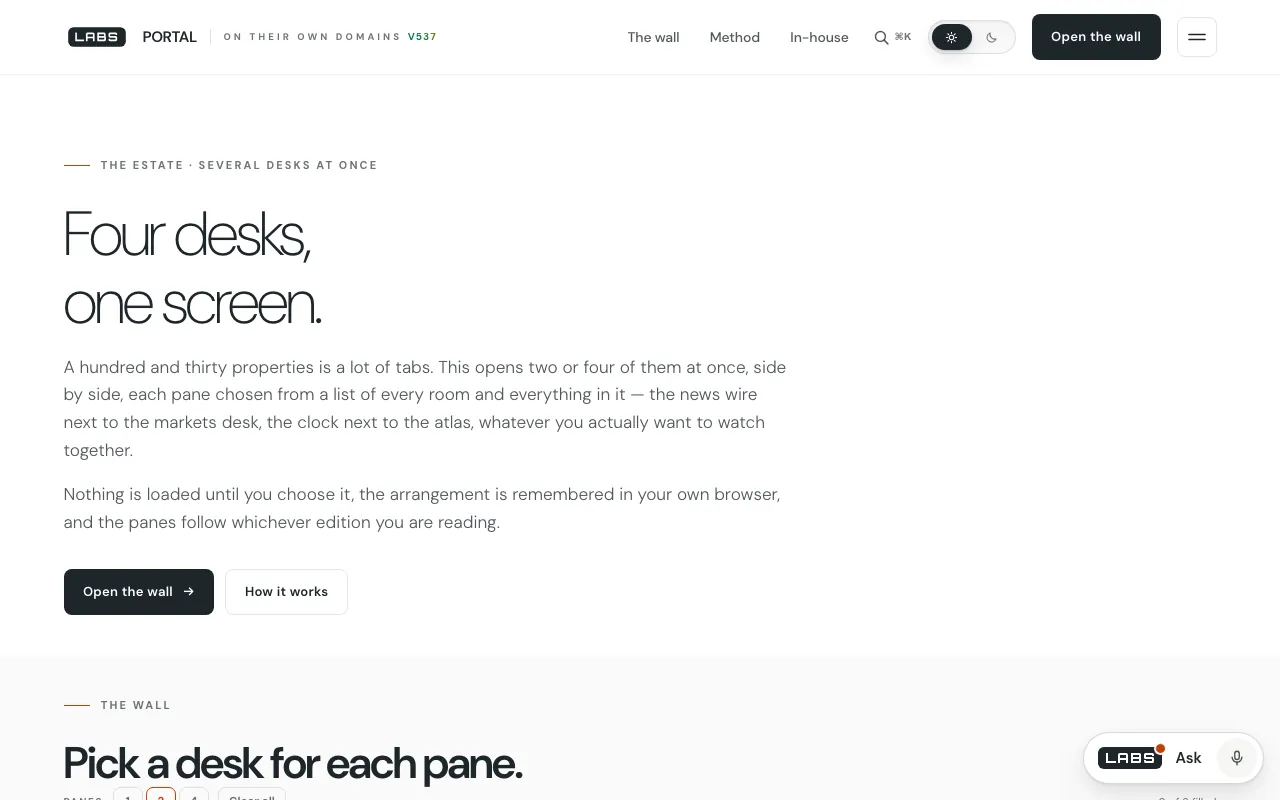
Portal turns one browser tab into a wall of one, two or four panes, each holding a live labs.llc desk chosen from a menu of every room on the site. Put the airports board in one pane and the Treasury desk in the next, and both run at once; the arrangement is still there on the next visit.
It is for regular labs.llc readers who watch several desks together, most usefully on a wide screen. Everything in it depends on the rest of the site, so it is as much a way into labs.llc as a tool of its own.
Wiring
Where the work happens
The menus are built from the site's register, window.LABS_PORTFOLIO in portfolio-data.js, grouped by shelf and sorted; records flagged as strip-only are skipped. Choosing a desk creates a lazily loaded iframe of the real page. Desks that live on other domains refuse to be framed, so their pane explains that and offers a new-tab link. The site's .htaccess sets X-Frame-Options: SAMEORIGIN and frame-ancestors 'self', which lets labs.llc frame its own pages and nobody else frame them. Layout and choices are stored in localStorage; nothing loads until a pane is filled.
Sources it reads
- None outside labs.llc: the menu is the site's own register, and each pane is a labs.llc page that fetches its own data.
Run table
The run, row by row
| # | Time | Probe | Returned |
|---|---|---|---|
| 01 | Loaded /portal/ from the local copy | HTTP 200, 35,342 bytes; portal.js is 9,325 bytes. | |
| 02 | Loaded the register in JavaScriptCore and applied the menu's own filter | 223 records; 179 selectable desks on 14 shelves (Earth 30, Internet 23, Markets 20, Sound 20, Brands 20, Utilities 17 and others). 71 of the 179 are on other domains. | |
| 03 | Looked for the framing headers on the wirenot run | Present in .htaccess (lines 458 and 528), but the local PHP server ignores .htaccess, so they could not be observed here. | |
| 04 | Read Vivaldi's Tab Tiling help pagerival page | Vertical, horizontal, grid and custom layouts; tiles resized by dragging; no fixed tab limit. | |
| 05 | Read Microsoft's Edge split-screen pagerival page | Two pages side by side in one tab; not on Edge mobile. |
Findings
The lengths it goes to
- The menu is generated from the site's register, so a desk added to labs.llc appears in the Portal the same day, filed under its room. On our count that is 179 desks across 14 shelves.evidence · portal.js 4–7, 52–70; run row 02
- A pane that cannot hold its desk says why and offers a link, instead of sitting there as an empty rectangle.evidence · portal.js 133–144
- Each pane is the live page with its own state and its own fetching, and the Portal says plainly that four panes cost four pages; a counter shows how many are filled.evidence · portal.js 15–17, 166–181
- Empty panes cost nothing and chosen ones load lazily, so opening the Portal loads no desk until you choose one.evidence · portal.js 124–129, 148
Against the field
Set beside 2 rivals
Vivaldi — Tab Tiling
A browser feature that shows several tabs at once — to compare, reference or monitor — in vertical, horizontal, grid or custom layouts.
Where it is ahead
- Any website, not just one site's pages.
- Tiles you can resize, and custom layouts.
- Built into the browser, so it works wherever you browse.
Where Portal goes further
- A ready-made catalogue of every labs.llc desk, grouped by room — a wall is two clicks, with no addresses to find.
- Works in any browser and remembers the wall between visits.
Microsoft Edge — Split screen
Two web pages side by side in a single Edge tab.
Where it is ahead
- Any two websites, including ones that refuse to be framed by other sites.
- Part of the browser, with no page to visit first.
Where Portal goes further
- Up to four panes rather than two.
- Explains in the pane why an outside property cannot be shown, rather than leaving a gap.
Faults
Where it falls short
- Its own pages only: 71 of the 179 listed desks open in a new tab instead of a pane, and nothing from the wider web can be added. Vivaldi's tiling and Edge's split screen take any website.
- Fixed layouts — one, two or four equal panes, no resizing — and below 860 px wide the panes stack in a single column.
- The header comment in portal.js says nineteen records are external; we counted 71. Documentation has fallen behind the register.
- Four live panes are four full pages loading and refreshing at once; the page itself warns about slow connections.
Sign-off
Log closed at
- Held up
- The register, read through the menu's own filter, gave 179 desks on 14 shelves, and the code answers an unframeable desk with words rather than a blank.
- Fell short
- Only labs.llc pages, in fixed equal panes.
- Reach for it when
- You watch two to four labs.llc desks together and want them picked from a list and remembered.
- Look elsewhere when
- You want pages from anywhere or panes you can size — use Vivaldi's tiling or Edge's split screen.