Run 08 · Live Intelligence · field test
Hanta: careful labels on a news watch that is not surveillance
We pulled the wire through its relay, aimed the relay at a cloud metadata address, counted the probe pools, and compared the desk with HealthMap and the CDC's case data.
Brief
What it is, and who it is for
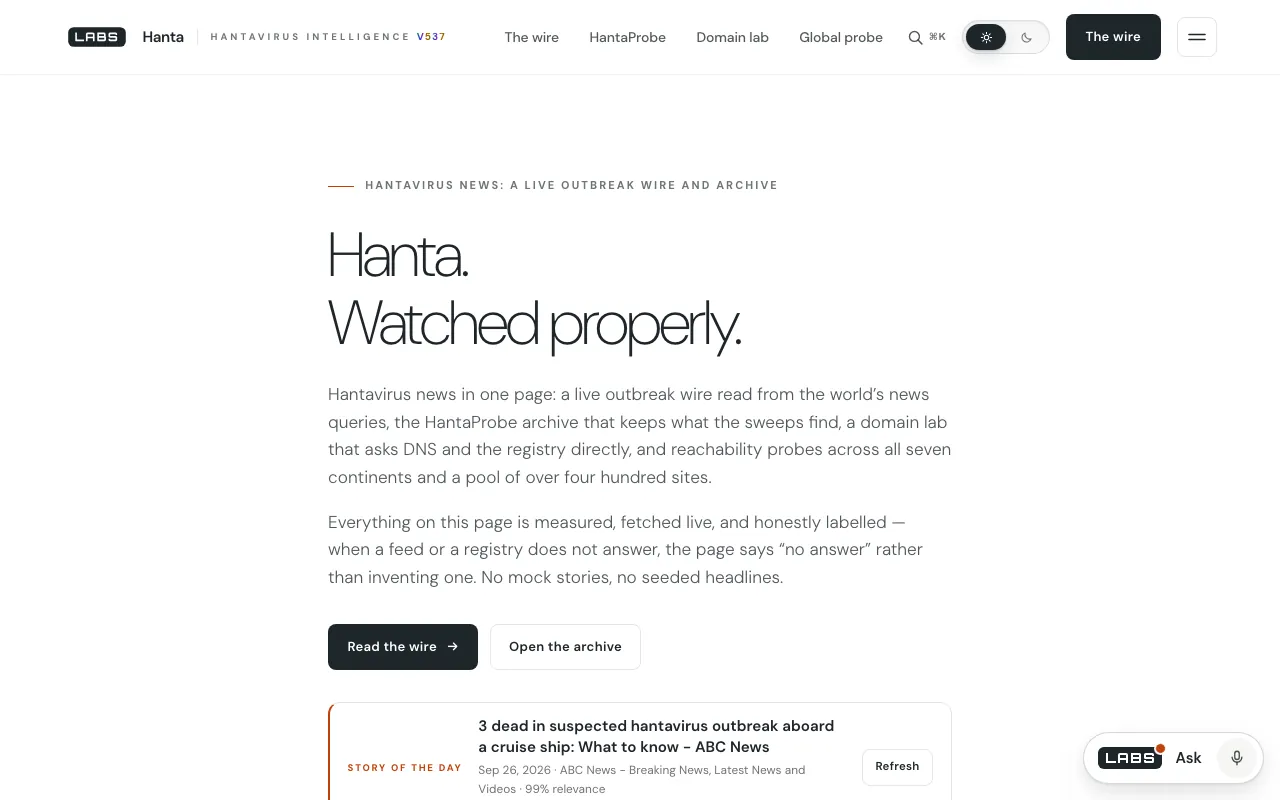
Hanta is a hantavirus news desk in five instruments: a live wire of Google News and Hacker News stories, the HantaProbe archive that keeps matching articles in the reader's browser, a domain lab that asks DNS and a registry's own RDAP server about any domain, and reachability probes to sites on seven continents plus a random sweep of a larger pool. Under the wire sits a curated 2026 dossier, labelled as the record.
It serves people following 2026's Andes virus cruise-ship cluster who want the newest headlines ranked by a rule they can see.
Wiring
Where the work happens
Google News searches come through rss-proxy.php, which takes its allowlist from feed-sources.php, follows redirects by hand and re-checks each hop, refuses literal IPs and private ranges, and caches feeds for 120 seconds. Hacker News comes straight from hn.algolia.com. Live stories are scored by relevanceOf(): 55 to start, +20 for a hantavirus term, +8 for outbreak words, +7 for a health authority, and +18, 12, 6 or 2 by age. The domain lab finds each registry's RDAP server from IANA's bootstrap file; reachability figures are timed browser requests labelled 'opaque timing', not pings.
Sources it reads
- Google News RSS searches, through the relay; the Hacker News search API, direct.
- IANA's RDAP bootstrap and each registry's own RDAP server; dns.google over HTTPS.
- Probe lists shipped with the page (31 continent sites, a 784-entry pool) and a curated 26-item dossier from the hanta.llc build.
Run table
The run, row by row
| # | Time | Probe | Returned |
|---|---|---|---|
| 01 | Loaded /hanta/ from the local copy | HTTP 200, 68,599 bytes. | |
| 02 | Relay: Google News search for 'hantavirus' | HTTP 200, 130,631 bytes in 0.62 s; 100 items; newest Sat 26 Sep 2026 20:03 GMT, on officials in Arizona and Georgia monitoring cruise passengers. | |
| 03 | Relay aimed at http://169.254.169.254/ | HTTP 400: 'Only absolute https URLs are accepted'. | |
| 04 | Loaded both probe lists in JavaScriptCore | Pool: 784 entries, 437 unique hosts. Continent test: 31 sites in 7 groups, three of them in Antarctica. | |
| 05 | Counted the curated dossier | 26 items, the first a CDC advisory of 8 May 2026 on the MV Hondius cluster, each with a relevance set by hand. | |
| 06 | Read HealthMaprival page | Filters by disease, location, source, species and date; saved searches; seven languages; email alerts. | |
| 07 | Read the CDC's hantavirus case-data pagerival page | 890 US cases, 1993 to end of 2023; 94% west of the Mississippi; page dated 23 Apr 2026. |
Findings
The lengths it goes to
- Live relevance is arithmetic you can read, and each card says whether its number was computed or set by hand for the dossier.evidence · app.js 409–427, 484–489
- When the wire fails, the page says so in words and shows the dossier 'dated as it stands', instead of serving old headlines as today's.evidence · app.js 395–402, 475
- The relay is hardened: an allowlist, every redirect re-validated, private ranges refused. Our probe at a cloud metadata address fell at the first check, which demands an absolute https URL.evidence · rss-proxy.php 9–23; run row 03
- Registry lookups go to each registry's own RDAP server via IANA's bootstrap file, never through an aggregator.evidence · app.js 7, 219–265
- Probe numbers are named for what they are: time to an opaque answer in your browser, not ICMP ping.evidence · app.js 294–313
Against the field
Set beside 2 rivals
HealthMap
An outbreak-alert map from Harvard Medical School and Boston Children's Hospital, covering human and animal disease.
Where it is ahead
- A map of alerts by place, filtered by disease, location, source and species.
- Many diseases and languages, and email alerts.
Where Hanta goes further
- A hantavirus-only wire ranked by a printed rule of subject, authority and age, with live and curated items kept apart.
- Failure stated on the page rather than stale headlines shown as new.
CDC — Hantavirus case data
The CDC's summary of reported US hantavirus cases by type and state.
Where it is ahead
- Official counts from the public-health authority: 859 pulmonary cases and 31 non-pulmonary since 2015.
Where Hanta goes further
- Today's reporting — the wire's newest item was from 26 Sep 2026, while the CDC's figures run to the end of 2023.
- An archive of up to 1,000 matched articles kept in your browser.
Faults
Where it falls short
- No case counts at all. This is news, not surveillance data; the CDC reports 890 US cases from 1993 to 2023.
- The pool the code calls its '1000-site pool' is 784 entries with only 437 unique hosts, and the reachability probes measure your own connection to big websites — which says nothing about a disease.
- HantaProbe matches words as broad as 'virus', 'disease' or 'medical', so its archive fills with unrelated health stories.
- The dossier's relevance numbers were chosen by a person and are frozen at the hanta.llc build.
- No map, no filters by place or species, no alerts — all of which HealthMap has.
Sign-off
Log closed at
- Held up
- The relay returned 100 current items in 0.62 s and refused an internal address.
- Fell short
- News, not case data; and the reachability probes add little to the subject.
- Reach for it when
- You want the latest hantavirus headlines ranked by a visible rule, with the record kept apart.
- Look elsewhere when
- You want case numbers (CDC) or an alert map across diseases (HealthMap).